

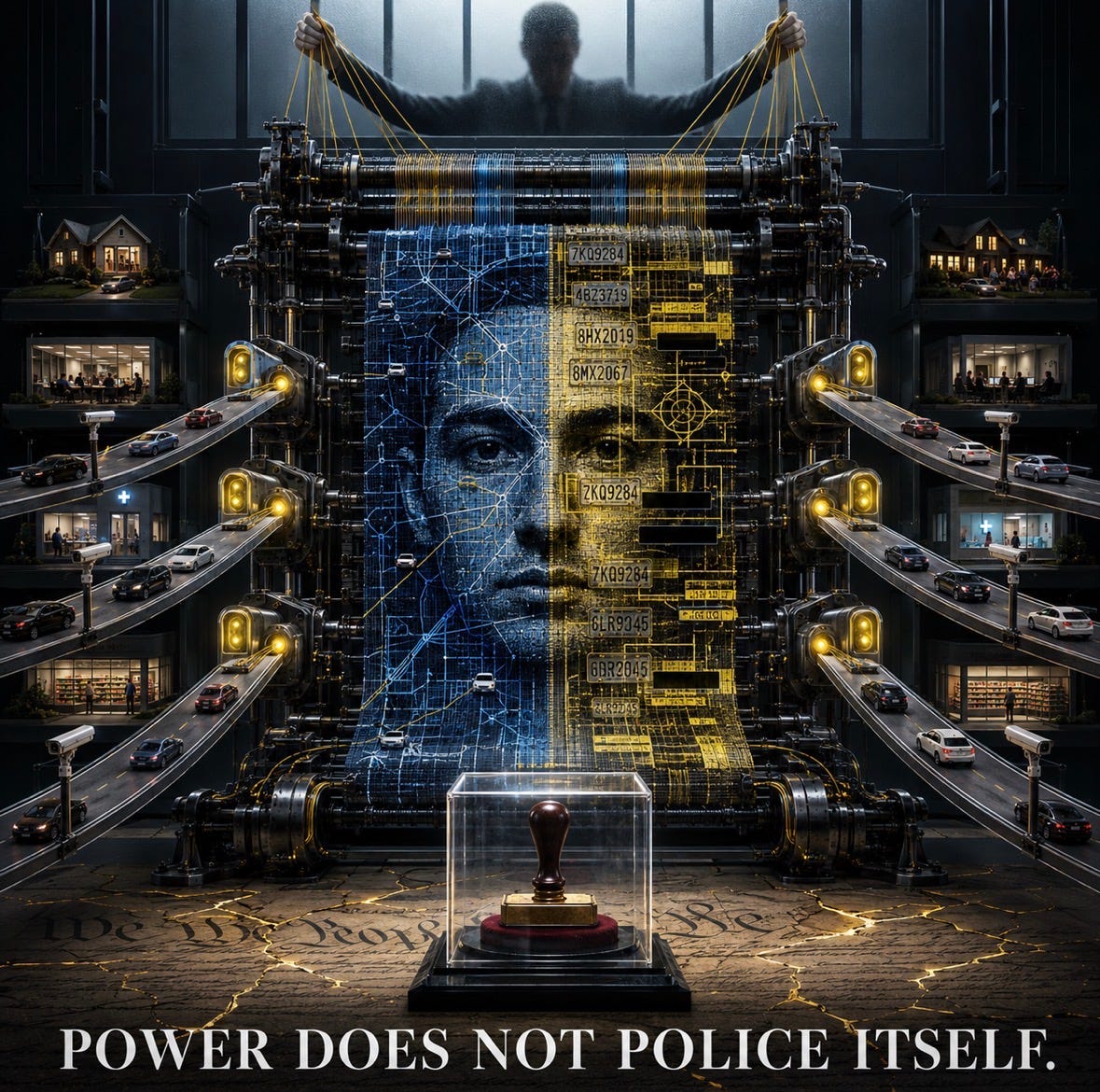
What are we even doing here? How does a country that never stops congratulating itself for its “due process” and protections of the “innocent until proven guilty” end up normalizing systems that track people first and ask questions later?
Flock cameras aren’t just about catching someone in the act. They create a searchable trail of where people drive, when they leave, who they see, and where they spend their time. Then that trail is handed to police departments and treated like a reservoir of possible suspicion. The assumption isn’t really that you’re innocent. It’s that you’re trackable, and therefore available to be investigated whenever someone with authority decides you’re worth looking at.
A plate reader alert isn’t proof of a crime. It’s a machine reading a plate under imperfect conditions and matching it to whatever data has been fed into the system. Plates get misread. Vehicles change owners. Tags are stolen. Records are wrong. But a mistaken “hit” can still become the beginning of a police narrative, and once they’ve settled on a person, almost anything can be made to look suspicious. Going to work, visiting someone, changing your route, being somewhere at an inconvenient time, for instance, and suddenly it all gets reframed as evidence.
And we’re supposed to trust that every officer with access will be principled, restrained, and incapable of using it for personal reasons? A badge doesn’t erase resentment, ego, obsession, prejudice, or the desire to control someone. It can give those things institutional cover. The officer who has a grudge, who’s politically vindictive, wants to keep tabs on an ex, or takes an unhealthy interest in someone they encountered doesn’t have to physically follow them anymore. They can simply pull up patterns of movement from behind a desk and call it “investigative work.”
That’s the part people keep trying to sweep under the rug: giving institutions more power doesn’t magically make the people inside them more trustworthy. It just gives their worst impulses more reach, secrecy, and legitimacy. Liberty lovers understand why this is dangerous. The government doesn’t collect this kind of power and then politely give it back. We’ve been pointing out the deeper problem forever: authority built on coercion will always find new ways to justify itself, expand itself, and insulate itself from consequences.
If the police have actual probable cause to track a specific person, they can go before a judge and ask for a warrant. If they can’t do that, then why should they have the power to sift through everyone’s movements anyway?
Privacy isn’t a favor the state grants to people it considers respectable. It’s a line that protects all of us from being turned into suspects on somebody else’s whim. Otherwise, what’s the point in having a constitution or the Bill of Rights?