

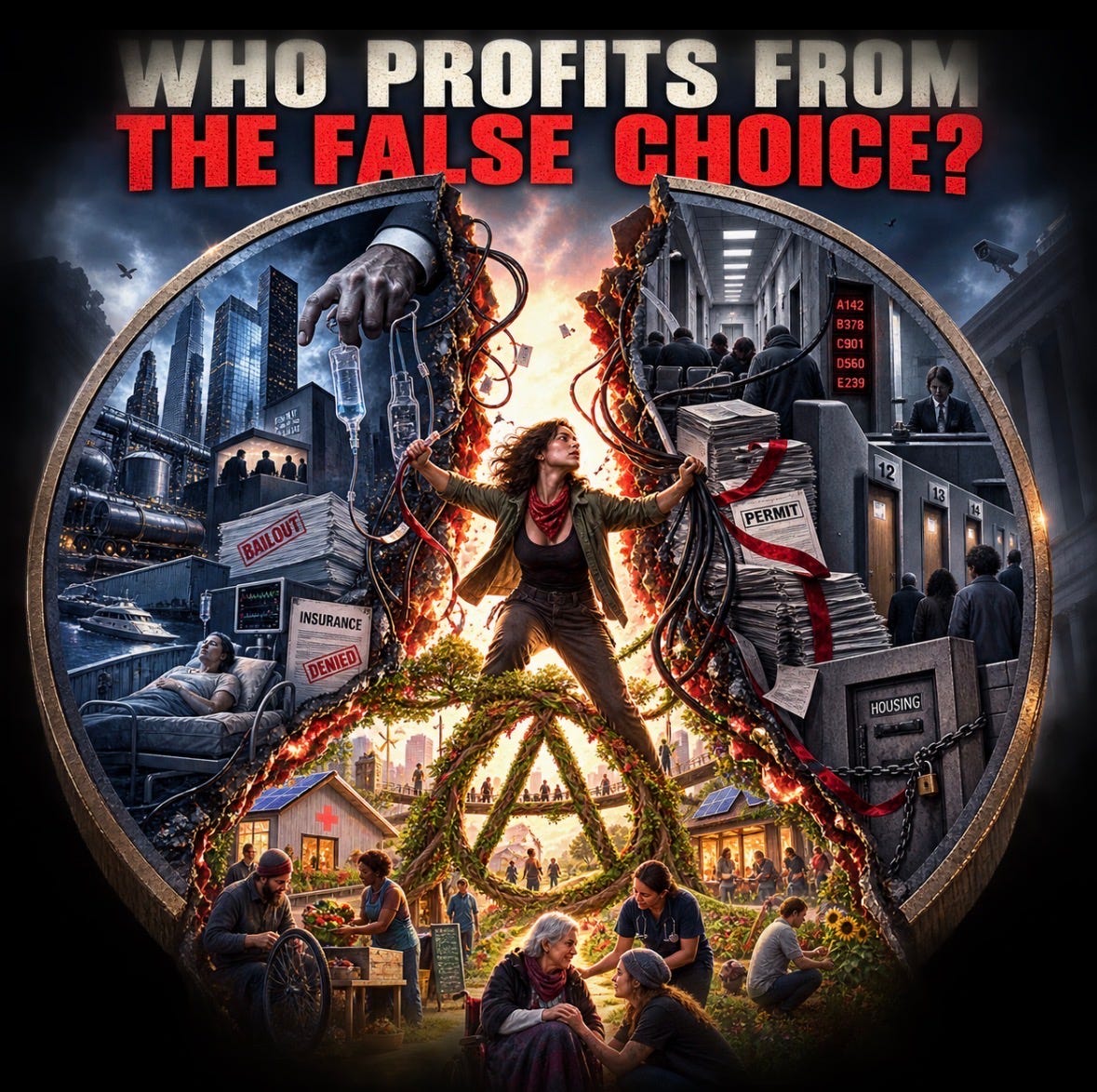
I don’t advocate corporatism, and I don’t find markets inherently offensive either.
As an anarchist, I’m not writing this in support of capitalism, socialism, nationalism, or any state managed economic system. I’m making a distinction that all too often is lost on most people. Recognizing what goes wrong within the systems people currently live under is not the same as endorsing those systems. Most people are still attached to a country, its institutions, currency, healthcare structure, and its economy whether they want to be or not. Until people have freer and more humane alternatives, it matters to talk honestly about how the existing structures could do less harm.
A genuinely free market is not the same thing as a corporate government cartel where well-connected businesses write regulations, receive bailouts, capture industries, suppress competition, and then call the result “capitalism.” That isn’t freedom. It’s privilege protected by power.
People should be free to earn, trade, barter with their neighbors, start small businesses, create voluntary currencies and mutual aid arrangements, own property, and profit from the value they create. Earning money, making a profit, and accumulating wealth aren’t inherently moral failures. The problem begins when wealth is built through manipulation, monopoly, political favoritism, predatory dependence, or a system designed to keep ordinary people permanently desperate.
I reject the arrogance of the political right when it acts as though putting profits over human lives is normal, acceptable, or inevitable. If a system treats people as disposable inputs, denies them lifesaving care, poisons communities, traps workers in poverty, or exploits crisis for profit, that isn’t liberty. It’s inhumanity with a price tag.
But I also reject the entitlement embedded in the “eat the rich” mentality, which is the bright idea that no one should be allowed to prosper beyond some arbitrary line, or that success itself automatically proves theft. People aren’t made equal by punishing achievement, confiscating every reward, or handing the state more control over their labor and choices. Wealth isn’t automatically exploitation any more than poverty automatically makes someone virtuous.
Both extremes fail because both reduce people to something that can be managed by corporations in one case and by bureaucracies in the other.
Canada and the United States show two different versions of the same underlying problem. Canada isn’t pure socialism, and the United States isn’t a free market. Both are economic hybrids. Canada leans more heavily toward centralized public systems, while the United States protects corporate power through regulation, subsidies, licensing barriers, insurance-company influence, and political connections.
Canada’s healthcare system does provide universal public coverage for many medically necessary hospital and physician services, but universal coverage doesn’t automatically mean timely access. People can wait months for specialist appointments, testing, surgeries, and routine care, even while the country faces doctor shortages and difficulty retaining medical professionals. Canada also has a serious housing affordability problem. People shouldn’t have to accept that they’ll be permanently priced out of stable housing in a country that calls itself compassionate.
That doesn’t mean the answer is to abandon people to an American-style system where profit is allowed to determine whether someone receives care at all. The United States has enormous medical resources, technological innovation, and world class treatment, but many Americans can’t afford coverage in the first place. Even people with insurance can be buried under deductibles, copays, exclusions, prior authorizations, denied claims, and medical debt. A person can technically “have insurance” and still be unable to afford the care they need.
Canada’s MAiD system raises another question that shouldn’t be dismissed with slogans. I’m not saying every person who chooses MAiD does so because of poverty, housing insecurity, disability, or lack of care. Many people facing terminal illness and unbearable physical suffering make an informed choice that they believe preserves their dignity.
But a society has a moral obligation to ask what “choice” means when a person can’t get adequate medical treatment, pain care, disability support, housing accommodations, income security, community care, or palliative support. No one should ever feel that death is more attainable than the help required to make life bearable.
That’s the distinction I’m making. I’m not asking for more state control, more bureaucratic authority, more corporate power, or blind loyalty to any economic ideology. I’m acknowledging that people still have to survive inside these systems, and that they deserve better than being told to choose between exploitation by corporations and control by the state.
The practical direction, as I see it, is to reduce concentrated power wherever it exists.
✅ The country should end corporate welfare, regulatory capture, bailout culture, and laws that allow politically connected businesses to dominate markets while calling it competition.
✅ The country should protect small-scale exchange, local trade, bartering, cooperatives, mutual aid, independent work, voluntary associations, and community currencies.
✅ The country should make it easier to build housing by removing artificial restrictions, exclusionary zoning, unnecessary permitting barriers, and policies that reward scarcity while ordinary people are priced out.
✅ The country should ensure that no one is denied essential emergency or catastrophic medical care because they’re poor, while also refusing to let either government bureaucracies or insurance companies control every medical decision.
✅ The country should expand access to doctors, nurses, clinics, training opportunities, independent care models, disability services, pain treatment, palliative care, housing options, and real community support.
And before a person is expected to see death as their only dignified escape, society should make damn sure they’ve been offered every meaningful way to live with dignity first.
I don’t need to worship billionaires, corporations, the state, or any ideology that demands obedience. I want a world where people can prosper without exploiting others, where no one is abandoned because they’re poor or sick, where communities are free to care for each other without asking permission, and where people retain the freedom to shape their own lives, exchanges, and futures.
That isn’t an endorsement of the systems we have. It’s an acknowledgment that while people are still forced to navigate them, they should at least be made less cruel, less coercive, and less hostile to human dignity.
So if neither corporate cronyism nor centralized state control has delivered real freedom, security, dignity, or access to life’s necessities, what would it look like to move forward by decentralizing power, strengthening voluntary community support, protecting individual autonomy, and making it easier for people to build stable lives without being controlled by either corporations or the state?
#CronyCapitalism #MarketManipulation #CorporateWelfare #Capitalism #Socialism #Poverty #Wealth #RegulatoryCapture #PeopleOverProfits