

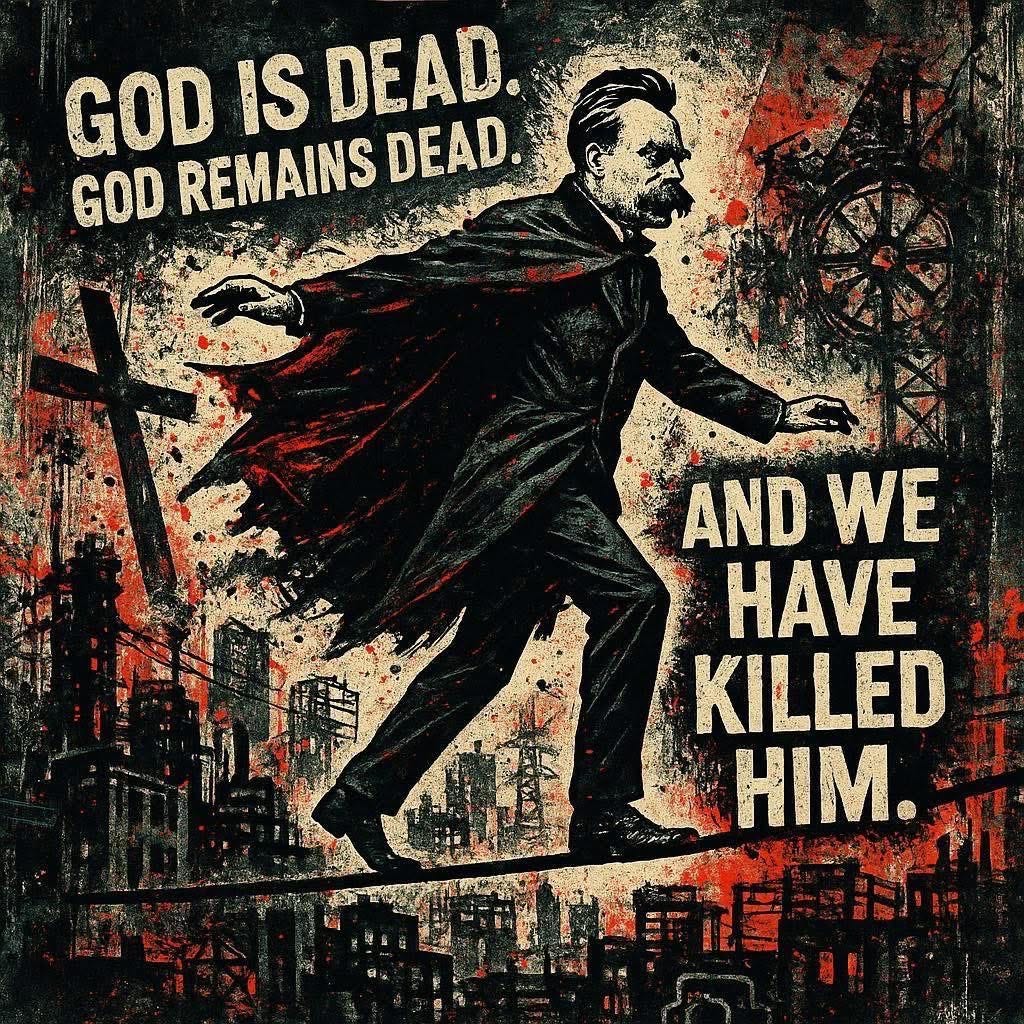
Nietzsche’s declaration “God is dead. God remains dead. And we have killed him,” is a metaphorical statement about the cultural and philosophical shift in Western society rather than a literal assertion of God’s death. It reflects the collapse of traditional divine and moral influences, particularly those grounded in Christianity, which once provided absolute, universal truths and meaning to life. Nietzsche observed that the Enlightenment movement, scientific rationalism, and secularization had eroded the belief in a transcendent God, leaving a void where the ultimate source of values and purpose used to be.
In Nietzsche’s view, this “death” of God created a profound existential crisis: nihilism, where life risks being seen as devoid of intrinsic meaning, value, or purpose. Without the grounding presence of God, people face a cultural and spiritual vacuum that can lead to despair, apathy, and meaninglessness. Nietzsche warned that the replacement of God by materialism, state worship, or secular ideologies fails to fill this void adequately. Instead, these substitutes often result in a cycle of cultural decline and existential emptiness.
But Nietzsche did not see this crisis simply as an end. He recognized it as a transitional moment. The loss of traditional values demands a revaluation of values and the emergence of self-determined meaning. Nietzsche believed the greatest challenge for humanity was to overcome nihilism by affirming life despite its inherent suffering and meaninglessness. This life-affirming stance requires enduring the inevitable suffering of separation from a society that once centered itself around divine meaning but now risks falling into eternal nothingness. For Nietzsche, this suffering was a catalyst for the rise of the “Übermensch” or “overman,” who creates new values and embraces self-determinism by transcending nihilism.
Nietzsche’s “God is dead” encapsulates a cultural and philosophical diagnosis: the decline of moral/divine and metaphysical absolutes has left humanity bereft of foundational meaning, potentially dooming it to nihilism. Yet, this death opens the possibility for humanity to create fresh values and affirm life in its fullness, including suffering, rather than retreat into despair or replace God with mere materialism or state power. This outlook reflects Nietzsche’s profound awareness of both the dangers and opportunities in modernity’s departure from theism.
If you’re one of Nietzsche’s critics, I hope you understand this often misunderstood statement better now.
I read it as an inversion of perspective. From the top down authoritarian Judeocentric paradigm , to the bottom up emergence of nested frequencies of consciousness. The frequency that we contribute to as aspects of a greater whole is the frequency over man.